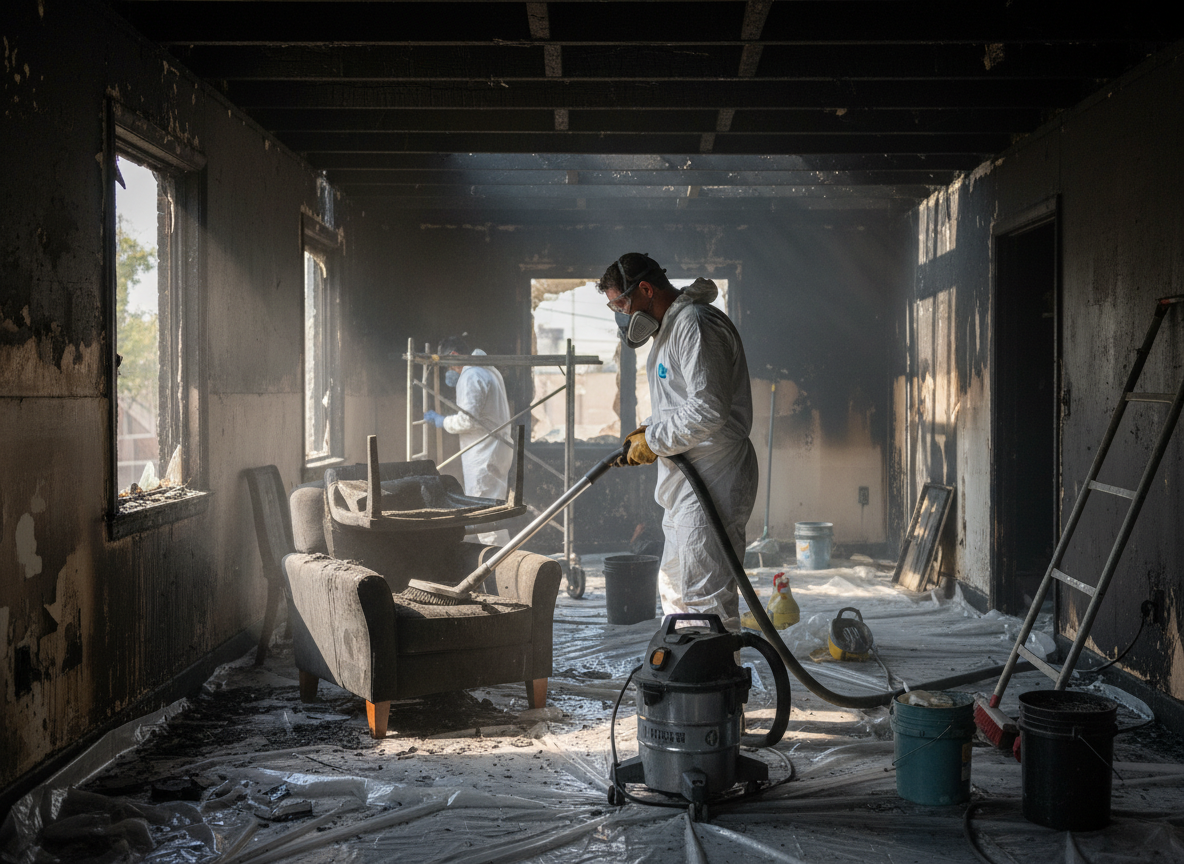
Valley Village homes built in the mid-century era often feature stucco exteriors and older HVAC ducting that trap smoke particles after fires. Warm dry summers common to the Mediterranean climate allow embers and soot to travel farther from the burn site into neighborhoods like North Hollywood West and near Laurel Canyon Park. Clean up crews must remove charred insulation and neutralize acidic residue on wood framing before corrosion sets in, especially when mild winters keep humidity levels low enough to prevent natural rinsing of surfaces.
Restoration work here frequently involves properties bordering Studio City and Sherman Oaks where hillside terrain funnels smoke into lower-lying Valley Village blocks. Technicians test for hidden char behind drywall and under flooring because the dry air prevents odors from dissipating quickly. Specialized HEPA filtration and thermal fogging address particulate that settles in crawl spaces common to the area's ranch-style houses, preventing recontamination once windows are reopened after the initial containment phase.
Los Angeles County building codes require documentation of removed materials when fire damage affects load-bearing elements, so crews photograph every step before drywall replacement. Crews working from Riverside Drive routinely coordinate with local inspectors on homes near Valley Village Park where mature landscaping can carry residual embers into attics. Proper disposal of contaminated carpet and cabinetry avoids secondary contamination in the mild winter months when residents begin using indoor heating again.
Technician insight
In Valley Village the thing that catches most people out with fire damage clean up is how smoke travels through the shared ductwork in 1950s ranch homes near Valley Village Park during the dry summer months, leaving residue that only shows up once the heat kicks on in winter.
Soot in North Hollywood West Attic
A summer fire several blocks away sent smoke into a Valley Village home near North Hollywood West. We found heavy soot inside the original metal duct runs and under the insulation. We contained the attic, removed the contaminated insulation, cleaned the ducts, and treated the framing before reinstalling new insulation.
How it works
- 1
Site Assessment
Inspect structural integrity, test for hidden soot in ducts and attics, and document affected materials in Valley Village homes.
- 2
Containment Setup
Isolate damaged zones with plastic barriers and negative air machines to prevent soot migration into unaffected rooms.
- 3
Soot and Residue Removal
Clean surfaces using HEPA vacuums and approved agents, focusing on wood, stucco, and HVAC systems typical in local construction.
- 4
Odor Neutralization
Apply thermal fogging and ozone treatment to address smoke trapped in insulation and older ductwork.
- 5
Final Verification
Reinspect with moisture meters and air quality checks before returning the property to the owner.
Pricing
Pricing varies with the volume of affected materials, depth of smoke penetration, and whether HVAC systems require full disassembly.