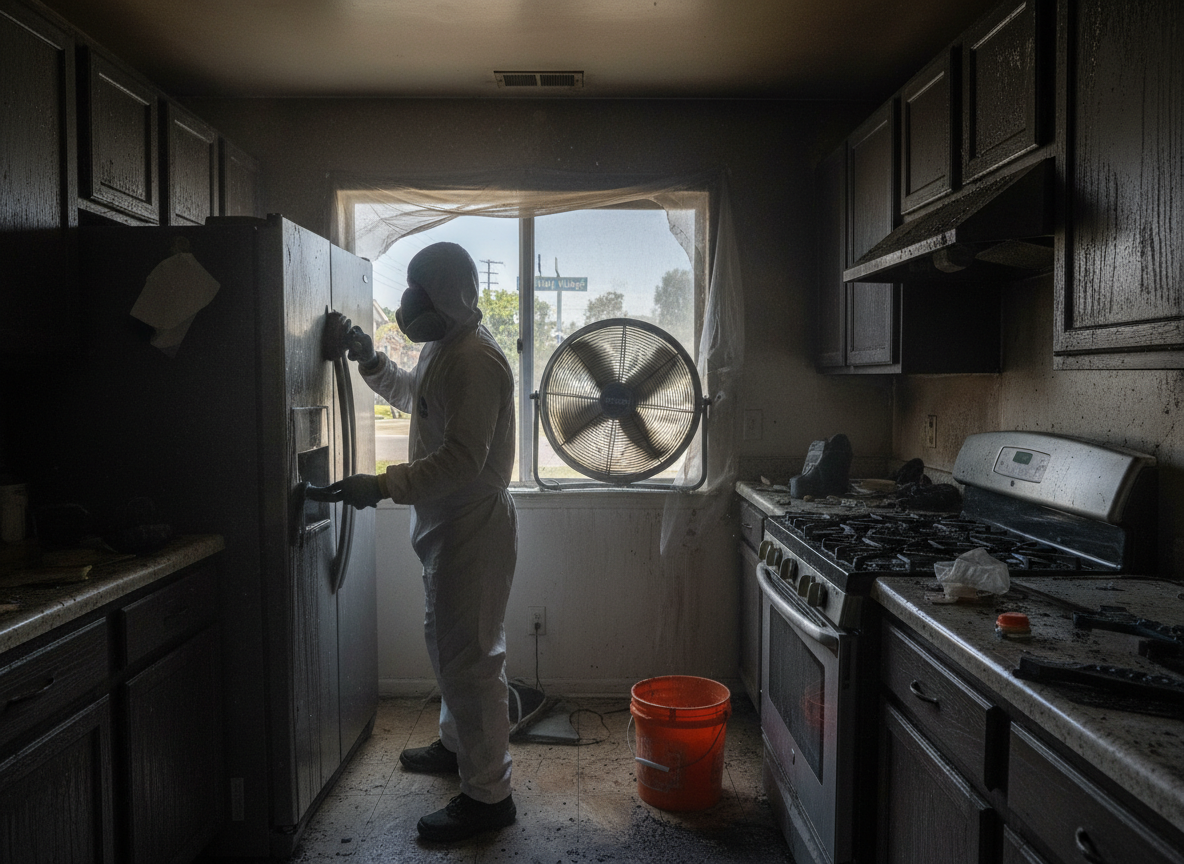
Kitchen fires in Valley Village often start from grease buildup or faulty appliances in mid-century homes common throughout North Hollywood West and near Valley Village Park. These properties frequently feature older cabinetry, laminate surfaces, and HVAC systems that trap smoke particles quickly due to the dry Mediterranean summers. Cleanup requires removing charred materials, neutralizing odors, and addressing residue that settles into porous drywall and insulation before it spreads to adjacent living spaces in neighborhoods bordering Studio City and Sherman Oaks.
Technicians begin by isolating the affected zone to prevent cross-contamination, then use specialized equipment to extract soot from ceilings and ducts while testing air quality. In Los Angeles County homes, code requirements for ventilation updates after fire events must be followed, especially when smoke has traveled through shared walls typical in Valley Village's denser blocks. Edge cases include hidden grease fires behind stoves that damage subflooring, requiring removal of contaminated underlayment to avoid future odors during mild winter rains.
Residents near Laurel Canyon Park face added challenges when winds carry smoke into nearby properties, embedding particles in fabrics and electronics. Proper disposal of burned cabinetry and appliances follows local regulations to prevent environmental runoff into the area's storm drains. Full restoration includes sealing surfaces with odor-blocking primers suited to the region's warm, dry conditions that can otherwise reactivate residues months later.
Technician insight
In Valley Village, the thing that catches most people out with Kitchen fire cleanup is how quickly smoke travels through the original 1950s plaster-and-lath walls common around Valley Village Park and North Hollywood West, especially when dry summer winds from Laurel Canyon push residue into hidden cavities that later release odors during the first mild winter rain.
Grease fire behind range in Valley Village home
A kitchen fire from an overheated pan spread soot through cabinets and into the HVAC in a 1960s ranch near Valley Village Park. We found residue had migrated into wall cavities and the laundry room. Containment, targeted cleaning, and duct sealing restored the home without full demolition.
How it works
- 1
Initial Assessment
Inspect the kitchen and surrounding areas for soot depth, smoke migration, and structural impact while documenting conditions for insurance.
- 2
Containment and Safety
Set up barriers and negative air machines to isolate the space and protect unaffected rooms from further particle spread.
- 3
Soot and Residue Removal
Clean surfaces, appliances, and ductwork using HEPA vacuums and chemical agents formulated for grease-based kitchen fires.
- 4
Odor Neutralization and Restoration
Apply sealants, replace damaged materials, and verify air quality before returning the space to use.
Pricing
Costs depend on fire size, smoke travel distance, and materials affected; upfront quotes provided after on-site evaluation.